Wondering about the best months to visit Vietnam? Discover month-by-month weather, regional breakdowns, and why the ideal time depends on your route.(CLICK HERE)
Table of Contents
The Best Months to Visit Vietnam depend on one thing most people forget when planning their trip: Vietnam is a very long country. And when someone asks me about the this, my answer is usually the same: it depends on the route.
Hanoi and Sapa in the north can be cold and foggy while Ho Chi Minh City is hot and tropical at exactly the same time. Central Vietnam follows a different rainfall pattern again. That means there is no single month when every part of Vietnam has perfect weather.
The best month to travel to Vietnam depends on where you want to go, what you want to do, and how much you care about rain, heat, humidity, beaches, trekking or clear mountain views.
For a trip that covers a large part of the country, March to May is generally one of the strongest periods. That is why I often point travelers toward the Best Months to Visit Vietnam rather than simply giving them one season and sending them on their way. March and April are particularly reliable for combining northern, central and southern Vietnam. May can still work very well, but temperatures start climbing and rain becomes more noticeable in parts of the north and south.
That does not mean you should avoid the other months.
I spent 50 days traveling from Hanoi to Ho Chi Minh City, moving through Hanoi, Sapa, Ninh Binh, Hue, Hoi An, Da Lat and Ho Chi Minh City. I went in January, which meant I experienced completely different weather without ever leaving Vietnam. Sapa was cold and foggy. Ninh Binh was cool. Hue and Hoi An were milder. Da Lat felt almost like another country. Ho Chi Minh City was warm.
So instead of looking for one perfect month, think about Vietnam in regions.
This guide breaks down Vietnam weather by month, the best times for each region, the worst periods for specific destinations, and what I learned from actually traveling across the country in January.
When Is the Best Time to Visit Vietnam?
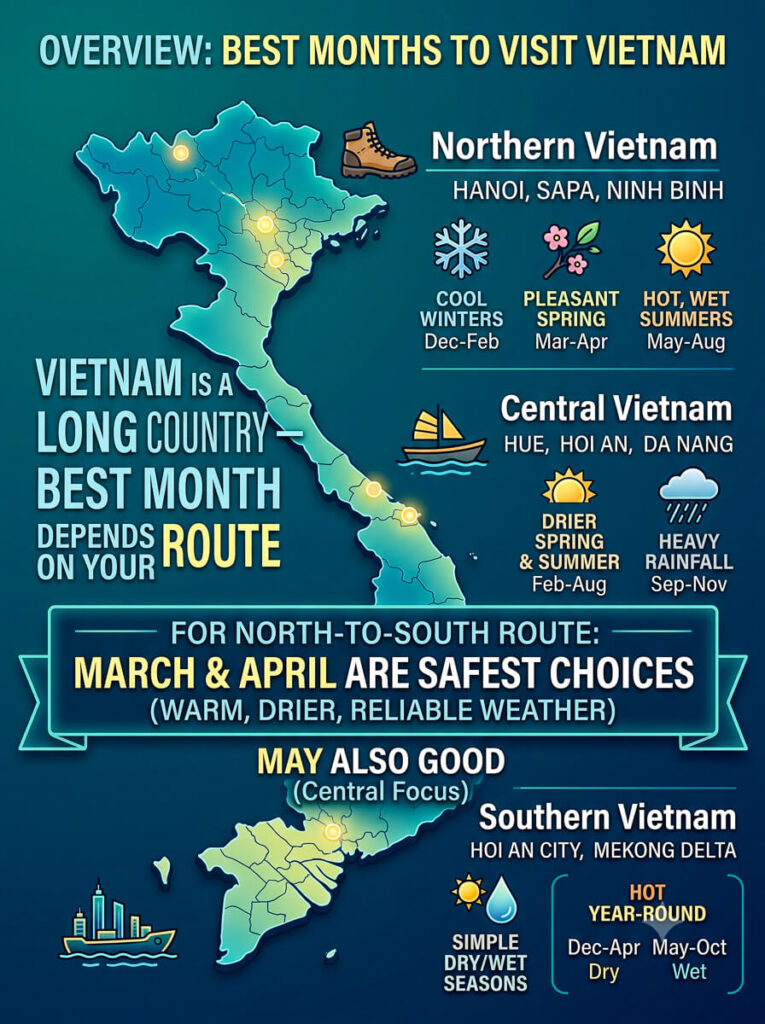
If you want the simplest answer, March and April are probably the safest choices for a first trip covering multiple regions.
Northern Vietnam is warming up after winter. Central Vietnam is generally entering one of its better periods for sightseeing and beaches. Southern Vietnam is still in its drier season before the wetter months become more established.
May can also be good, especially if you want more time in central Vietnam or are comfortable with heat. But by then, parts of the north and south are becoming hotter and wetter.
The important thing is not to treat Vietnam as one climate zone.
Northern Vietnam has cooler winters and hot, humid summers. The north also receives more rain through the warmer months. Sapa is different again because of its elevation, which makes it much cooler than Hanoi.
Central Vietnam has its own rhythm. Hue, Hoi An and Da Nang are generally drier through much of the first half of the year, while rainfall becomes more significant later in the year. The central coast can be excellent for beaches in spring and summer, but conditions change toward the autumn.
Southern Vietnam stays warm throughout the year. Instead of a cold winter, you get a broad dry season and wet season. Ho Chi Minh City and the Mekong Delta are generally easier to explore during the drier months, although rain does not automatically ruin a trip.
So the best time to travel to Vietnam is really a question of which Vietnam you want to experience.
For a north-to-south route, I would look most closely at March and April. For a specific region, the answer changes.
Vietnam Weather by Region
Northern Vietnam
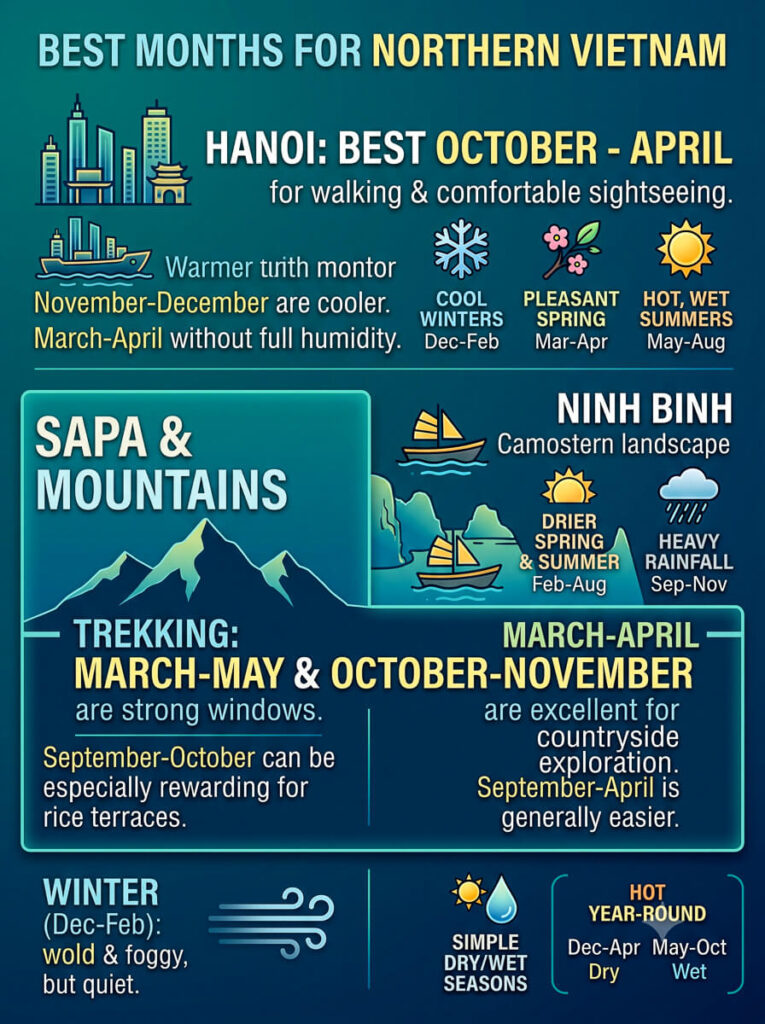
Northern Vietnam includes Hanoi, Sapa, Ninh Binh, Ha Long Bay and the mountains around the Chinese border.
Winter, roughly from December through February, can be surprisingly cold. Hanoi can feel chilly and grey, while Sapa can become genuinely cold because of its elevation. Fog is also common in the mountains.
Spring, particularly March and April, is a much easier time for outdoor activities. Temperatures become more comfortable, skies can improve and trekking conditions in Sapa are generally better.
May through August is hotter, more humid and wetter. Northern Vietnam can receive heavy rain during this period. Trekking is still possible, but trails can become muddy and mountain visibility is less predictable.
September and October are especially interesting for Sapa and northern mountain regions. The landscapes are green, temperatures begin to ease and the rice terraces can look spectacular around harvest season, although the exact appearance changes from year to year.
November can be a great month for comfortable sightseeing in Hanoi and Ninh Binh. December brings cooler conditions again.
For trekking, March to May and October to November are among the better windows. But Sapa has an important rule: there is no month that guarantees clear mountain views. I learned that the hard way.
Central Vietnam
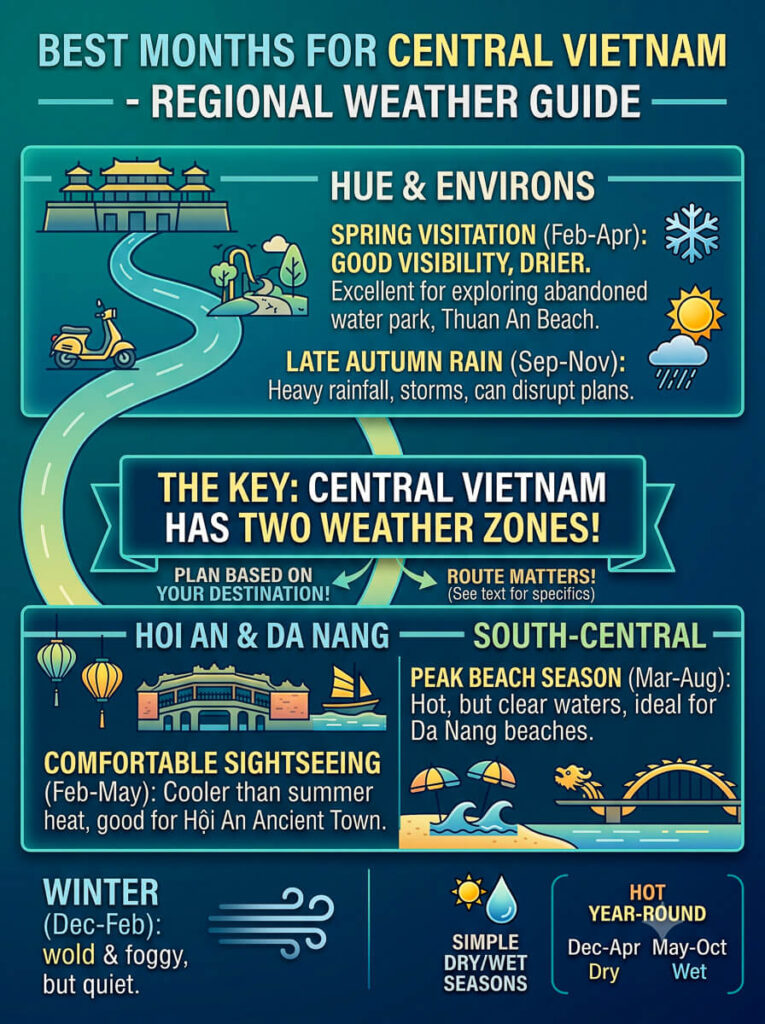
Central Vietnam is where trip planning gets interesting because its rainy season does not follow the same pattern as the north.
Hue, Hoi An and Da Nang generally have a more comfortable window from around February or March through the summer, with especially good conditions in spring. Temperatures rise significantly as you move toward June and July, but beach days can still be excellent.
The wetter period becomes more important later in the year, particularly from around September through November. Central Vietnam can receive heavy rainfall during these months, and storms can affect travel plans.
For sightseeing, February through May is a strong window. March and April are particularly comfortable if you want to explore cities, temples, countryside roads and beaches without dealing with the heaviest rainfall.
For beaches, late spring and summer can work well around Da Nang and Hoi An, provided you are comfortable with heat.
Hue deserves an extra mention. It is one of those places where weather can completely change the experience. I spent five days there and loved exploring beyond the Imperial City, including the abandoned water park, Thuan An Beach and Rung Ru Cha. Dry weather made riding a scooter between these places much easier.
Southern Vietnam
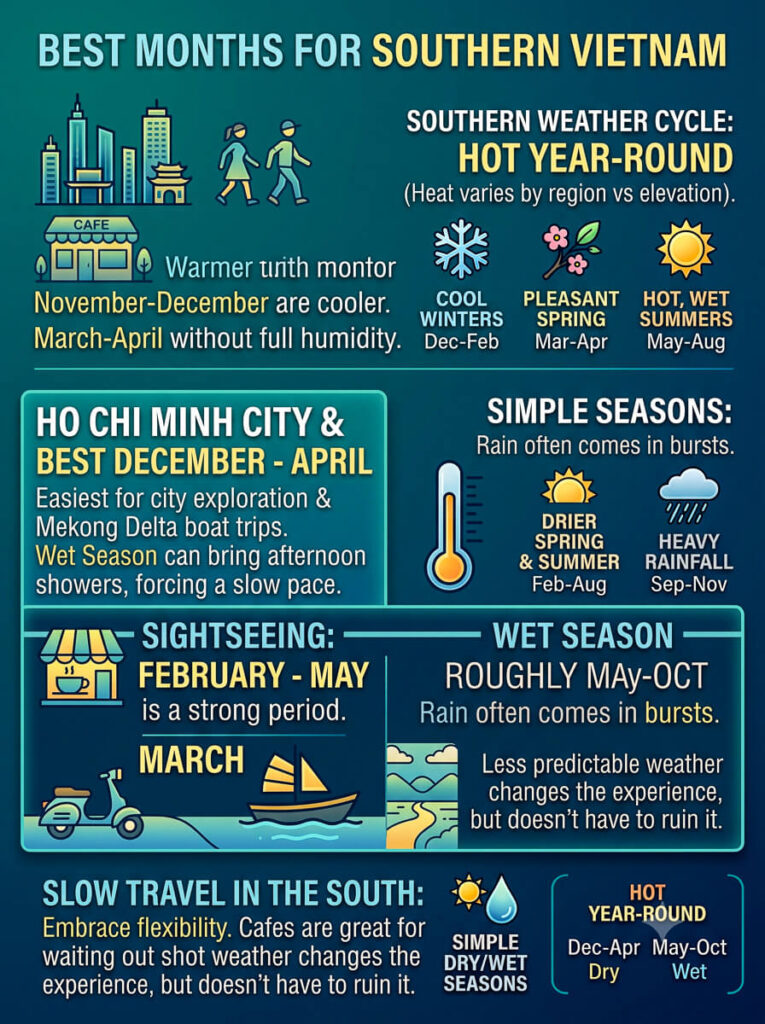
Southern Vietnam is much simpler from a temperature perspective. It stays hot.
Ho Chi Minh City is warm and humid throughout the year, while the Mekong Delta has a tropical climate with a distinct wet and dry season.
The drier months, roughly December through April, are generally the easiest for sightseeing. January through March can be particularly comfortable by southern Vietnam standards, although “comfortable” still means hot compared with the north.
The wet season usually becomes more established from May through October. Rain can be heavy, but it often arrives in bursts rather than lasting all day. A rainy afternoon does not necessarily mean you have lost the entire day.
The benefit of visiting during the wetter period is that you can sometimes find greener landscapes and fewer tourists. The downside is that you need to be more flexible.
If your priority is easy city sightseeing, December to April is the safer bet. If you are happy with heat and occasional storms, the south is a year-round destination.
Best Months to Visit Vietnam, Month by Month
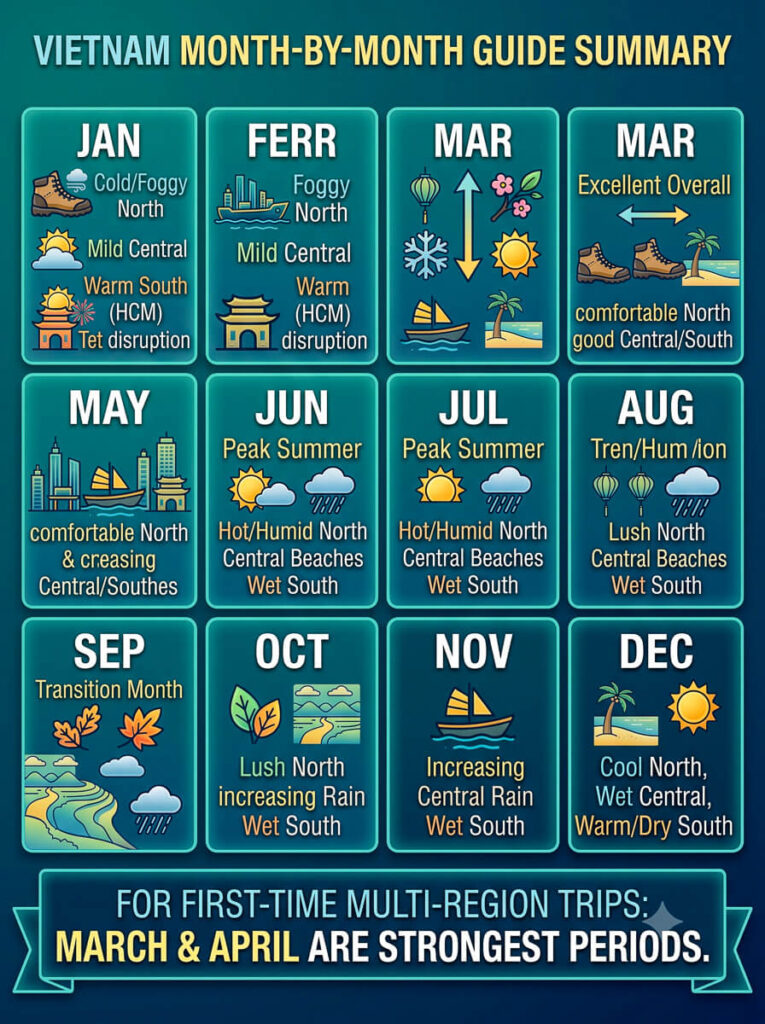
January
January is one of the most interesting months to visit Vietnam because the country can feel completely different from north to south.
Northern Vietnam is cool, and Sapa can be cold and foggy. Hanoi can have grey, overcast days. Ninh Binh is cooler and comfortable for riding around the countryside, but you will want layers in the morning and evening.
Central Vietnam is usually milder, although Hue and Hoi An can still experience cloudy or wet days.
Southern Vietnam is warm and much more tropical. Ho Chi Minh City is a completely different experience from Hanoi at this time of year.
The biggest thing to watch is Tet. The date changes every year because it follows the lunar calendar, usually falling in late January or February. Around Tet, transport becomes busy, businesses close and accommodation can become harder to find.
I was in Ninh Binh during Tet and it completely changed my plans. I originally expected to stay around four or five days. I ended up staying 11. Restaurants closed. Transport became limited. Many businesses shut down. What should have been a short stop became a slow, quiet stay.
That sounds inconvenient. It was. But it was also one of the most memorable parts of my trip.
Best for: Southern Vietnam, quieter northern travel, slow travel, and travelers who do not mind cold weather.
Downside: Sapa can be foggy and cold, and Tet can disrupt transport and services.
February
February is a transition month.
Northern Vietnam starts to move away from the coldest part of winter, although Hanoi and Sapa can still be cool. Sapa may remain foggy, especially in the mountains.
Central Vietnam starts becoming more attractive for sightseeing. Hue, Hoi An and Da Nang can have increasingly pleasant conditions, although weather can still change.
Southern Vietnam is usually hot and relatively dry.
Tet may fall in February depending on the year, so always check the exact dates before booking. Do not assume that February is automatically normal travel season.
February works well for travelers who want a mix of regions without the hotter conditions that arrive later in spring.
Best for: Central Vietnam, southern Vietnam, and travelers who want fewer crowds than the major spring peak.
Downside: Northern mountain weather can still be unpredictable.
March
March is one of my favorite answers to the question of the best time to visit Vietnam.
The north is becoming much more comfortable. Sapa is warming up, trekking conditions improve and Hanoi becomes easier to explore on foot without winter chill or summer humidity.
Central Vietnam is also in a strong period. Hue, Hoi An and Da Nang can have good conditions for sightseeing, cycling, scooter rides and beach time.
In the south, the weather is still generally dry, although temperatures remain high.
This is also why March works so well for a multi-region itinerary. You can start in Hanoi, head north to Sapa or Ninh Binh, continue through central Vietnam and finish in the south without deliberately choosing the rainy season in one region just to get good weather in another.
There will always be exceptions. Vietnam does not run on a perfect weather schedule. But March gives you a very good balance.
Best for: First-time visitors, long routes, trekking, sightseeing and multi-region trips.
Downside: Temperatures are beginning to rise, especially in the south.
April
April is another strong month and probably the best balance for travelers who want warm weather without the full intensity of summer.
Northern Vietnam is usually comfortable for Hanoi, Ninh Binh and outdoor activities. Sapa is a good option for trekking before the wetter months become more dominant.
Central Vietnam is particularly attractive. Hoi An, Da Nang and Hue can have good conditions for exploring and beach trips.
Southern Vietnam remains hot and mostly dry, although heat and humidity can be intense.
The main disadvantage is that temperatures start climbing everywhere. A scooter ride through the countryside may be perfect in the morning and exhausting in the afternoon.
Still, for travelers asking about the best month to travel to Vietnam across multiple regions, April is one of the easiest recommendations.
Best for: First trips, beaches, outdoor activities, and north-to-south itineraries.
Downside: Increasing heat, especially in southern Vietnam.
May
May is the start of the more complicated weather period.
Northern Vietnam becomes hot and humid, with increasing rainfall. Sapa can still be good, but trekking conditions become more dependent on rain.
Central Vietnam can be excellent, especially for beach trips around Da Nang and Hoi An. Hue can also be enjoyable before the heavier rains arrive later in the year.
Southern Vietnam moves more clearly into the wet season. You may get heavy tropical rain, but usually not constant rain from morning to night.
May is still a good month to visit. It just requires more tolerance for heat.
If your trip is focused on central Vietnam, May can be a very good choice. If you are planning to spend weeks trekking in the north, I would consider March or April first.
Best for: Central Vietnam, beaches and travelers comfortable with heat.
Downside: Rising humidity and increasing rain in the north and south.
June
June is hot.
Northern Vietnam is humid and receives more rain. Hanoi can feel exhausting in the middle of the day, while mountain regions are greener but wetter.
Central Vietnam is often one of the better parts of the country in June. Da Nang and Hoi An can have strong beach conditions, although temperatures are high.
Southern Vietnam is firmly in the wet season. Rain showers and thunderstorms are common, particularly later in the day.
June still makes sense for a traveler who wants beaches, does not mind heat and is flexible about outdoor plans.
It is less attractive for someone who wants cool weather, long hikes and predictable conditions.
Best for: Central Vietnam beaches, relaxed trips and travelers who handle heat well.
Downside: High humidity and frequent rain in northern and southern regions.
July
July is peak summer weather.
Northern Vietnam is hot, humid and rainy. Trekking can be muddy, and mountain visibility can change quickly.
Central Vietnam remains one of the more appealing regions, especially if your priority is beaches around Da Nang and Hoi An. Expect strong heat.
Southern Vietnam is wet and humid, with frequent rain showers.
The best type of trip in July is one that allows you to slow down. Spend mornings outdoors, take breaks during the hottest hours and avoid creating a schedule that depends on perfect weather every day.
Best for: Central Vietnam, beach trips and flexible itineraries.
Downside: Heat, humidity and rainfall across much of the country.
August
August continues the hot and wet summer pattern.
Northern Vietnam is very green but wet. If you visit Sapa, expect muddy trails and changeable mountain weather. This can still be a beautiful time for photography because the rice terraces and hills are lush.
Central Vietnam can still be a good beach destination, although heat is strong.
Southern Vietnam continues through the wet season. Ho Chi Minh City can have intense afternoon rainfall, which is more of an inconvenience than a reason to cancel the trip.
August works best for travelers who are flexible and do not expect every day to be sunny.
Best for: Green northern landscapes, central beaches and slow travelers who can work around showers.
Downside: Rain and humidity.
September
September is a transition month.
Northern Vietnam starts becoming more attractive as the worst summer heat begins to ease. Sapa and other mountain areas become especially interesting toward the end of the month, with lush rice terraces and improving conditions.
Hanoi can be more comfortable than in the peak summer months.
Central Vietnam starts moving into its wetter period, so the equation changes. Hoi An and Hue can still be enjoyable, but you should pay closer attention to the forecast.
Southern Vietnam remains wet and humid.
September is a good example of why Vietnam cannot be reduced to one answer. The north may be getting better at exactly the moment central Vietnam is becoming wetter.
Best for: Northern Vietnam, Sapa and rice terraces.
Downside: Increasing rain in central Vietnam and continued wet-season conditions in the south.
October
October can be excellent for Northern Vietnam.
Temperatures are more comfortable. Hanoi is easier to explore. Sapa can have clearer conditions, and the rice terraces can be spectacular around harvest season.
Ninh Binh is also a good option if you want cooler countryside riding and outdoor exploration.
Central Vietnam is a different story. Rain becomes much more important in Hue, Hoi An and surrounding areas, and heavy rainfall can disrupt plans.
Southern Vietnam can still be wet, although conditions begin to improve as the month progresses.
For a northern-focused trip, October is one of the best months. For a full-country route, you need to make a trade-off.
Best for: Hanoi, Sapa, Ninh Binh, trekking and mountain landscapes.
Downside: Central Vietnam can be very wet.
November
November is another month where regional differences are obvious.
Northern Vietnam becomes cooler and more comfortable. Hanoi is pleasant for walking and cafe hopping. Sapa can have crisp weather and better mountain visibility.
Central Vietnam is often still wet, particularly in Hue and Hoi An. This can be one of the least reliable periods for a central Vietnam beach holiday.
Southern Vietnam starts moving toward its drier period. Ho Chi Minh City becomes easier to explore, and the Mekong Delta starts looking more attractive.
So November is excellent for a north and south combination, but less reliable for a classic Hanoi-Hue-Hoi An beach-focused route.
Best for: Northern Vietnam, trekking and Southern Vietnam.
Downside: Rain in Central Vietnam.
December
December brings cooler weather back to the north.
Hanoi can feel surprisingly cold by Southeast Asian standards, while Sapa can be genuinely chilly and foggy. Bring layers if you are heading into the mountains.
Central Vietnam can still be wet, particularly in the first part of the month, although conditions vary.
Southern Vietnam is one of the most reliable parts of the country in December. It is warm, tropical and entering the drier period.
December works particularly well if you want Southern Vietnam or a mixed itinerary that does not depend on perfect conditions in the central coast.
Best for: Southern Vietnam, Ho Chi Minh City and travelers who enjoy cooler northern weather.
Downside: Cold and fog in the north, rain in parts of Central Vietnam.
Best Months to Visit Northern Vietnam
When I break down the Best Months to Visit Vietnam, Northern Vietnam is usually the region that changes the answer the most because of its cooler winters and mountain weather.
For Northern Vietnam, I would separate cities from mountains because the answer is slightly different.
Hanoi: October to April is generally the most comfortable period for walking around the city. November and December are cooler. March and April are warmer without the full summer humidity.
Sapa: March to May and October to November are strong windows for trekking. September to October can be especially rewarding for rice terraces. December to February is cold and foggy, but it can be quieter.
Ninh Binh: March to April and October to November are excellent for comfortable outdoor exploration. September through April is generally easier than the hot, wet summer months.
Trekking: March to May and October to November are among the better windows. Avoid assuming that any month guarantees clear skies.
Rice terraces: September and October are especially interesting around Sapa, although exact harvest timing changes with weather and local farming conditions.
Comfortable sightseeing: March, April, October and November give you a good balance of temperature and outdoor conditions.
My own Sapa experience is the best warning here. I visited in January expecting mountains and ended up with fog on most mornings. Out of seven days, only around three gave me decent visibility. On one planned scooter ride to Ta Van, the fog became so thick that I turned around.
Sapa was still one of my favorite stops.
That is the point. The best months improve your odds. They do not guarantee perfect weather.
Best Months to Visit Central Vietnam
The Best Months to Visit Vietnam for Central Vietnam are not necessarily the same months I would choose for Sapa or Ho Chi Minh City.
Central Vietnam is usually at its most useful to travelers from around February or March through the summer, depending on exactly what you want.
Hue: February to April is a particularly good window for sightseeing and exploring outside the city center.
Hoi An: February to July can offer good conditions, with spring being especially comfortable before the full summer heat.
Da Nang: March through August can work well for beaches, although June through August can be very hot.
Sightseeing: February to May is one of the strongest periods.
Beaches: March through August can work well, with the biggest variable being heat rather than rain in the earlier part of that window.
Rainy season: Roughly September to November is the period to watch most carefully, especially around Hue and Hoi An.
Hue was one of the places where weather mattered most to me. I spent five days there with a scooter, and several of my favorite experiences involved riding outside the city. The abandoned water park, Thuan An Beach and Rung Ru Cha were much easier to enjoy because I had dry roads and enough flexibility to choose when to go.
That is something I would keep in mind for Central Vietnam. If you want to explore beyond the obvious attractions, give yourself weather flexibility.
Best Months to Visit Southern Vietnam
For Southern Vietnam, the Best Months to Visit Vietnam are much easier to narrow down because temperature stays warm year-round and rainfall becomes the bigger seasonal variable.
Southern Vietnam is the easiest region to plan around temperature because there is no cold season.
Ho Chi Minh City: December to April is generally the easiest period for sightseeing, with less rain and more consistent dry conditions.
Mekong Delta: December to April is a reliable window, especially if you want easier boat trips and outdoor exploration.
Dry season: December to April.
Wet season: Roughly May to October.
Heat: It stays hot year-round. Even the “cooler” months are warm compared with Northern Vietnam.
The wet season is not automatically a bad time to visit. I actually like traveling in places where the weather forces you to slow down. In Ho Chi Minh City, you can visit a cafe, wait out an afternoon shower and continue exploring later.
The main thing is not to build a schedule around six hours of outdoor activities every day.
What Is the Worst Month to Visit Vietnam?
There is no single worst month to visit Vietnam.
There are only months that are worse for specific plans.
October and November can be difficult for Central Vietnam because of heavy rain.
May through August can be uncomfortable for Northern Vietnam if you dislike heat, humidity and rain.
December through February can be frustrating in Sapa if you want clear mountain views.
May through October can be wet in Southern Vietnam.
And January or February can become logistically difficult if your trip overlaps with Tet.
So instead of asking, “What is the worst month to visit Vietnam?” I would ask, “What weather am I willing to accept for the experience I want?”
I would happily return to Vietnam outside the traditionally recommended months.
Rain does not automatically ruin a city.
Fog does not automatically ruin Sapa.
Heat does not automatically ruin Hoi An.
Sometimes weather simply changes the type of trip you have.
The mistake is expecting Vietnam to give you perfect weather every single day.
Best Time to Visit Vietnam for Different Types of Travelers
Best Time for a First Trip to Vietnam
For a first trip that combines Northern, Central and Southern Vietnam, I would choose March or April.
You get a strong balance between regions. Northern Vietnam is becoming comfortable, Central Vietnam is generally good for sightseeing, and the south is still relatively dry.
February can also work. May is possible if you are comfortable with heat.
If your trip is only two weeks long, weather matters more because you have less room to wait out a bad forecast.
Best Time for Backpacking Vietnam
March and April are excellent for backpackers because the weather is relatively balanced and you can move through several regions without planning your entire route around one rainy season.
That said, backpacking Vietnam during the wet season can still work. You just need flexibility.
I used sleeper buses for most of my long-distance travel. I did not plan every day around perfect weather. Some days became travel days. Some became work days. Some became rest days.
That approach matters more than finding a perfect calendar month.
Best Time for Slow Travel
This is where Vietnam gets more interesting.
For slow travel, I would rather have a month with 80 percent good weather and 20 percent unpredictable weather than a month when I feel forced to rush from attraction to attraction.
March and April are strong choices. October and November can also be excellent in the north.
But January taught me that slow travel changes your relationship with weather.
I spent seven days in Sapa. When the mountains disappeared into fog, I worked from a cafe. When the fog lifted, I trekked. In Ninh Binh, Tet effectively stopped my original plans. I stayed anyway. I worked. I rode around empty roads. I slowed down.
That is what slow travel is supposed to look like.
Best Time for Beaches
The best beach month depends entirely on which coast you want.
For Da Nang and Hoi An, spring through summer is generally a strong period, with March to May offering a good balance before the hottest part of the year.
For Southern beach destinations, the dry season becomes more important.
Do not assume that because one Vietnam beach is rainy in November, every beach in the country is rainy too. The regional differences are significant.
Best Time for Trekking
For Sapa, March to May and October to November are among the best choices.
The weather is generally easier for long walks, and visibility can be better than in the winter fog season or summer monsoon.
But trekking in Sapa always requires some flexibility.
I went in January. The temperature was cold, fog was common, and one of my scooter plans had to be abandoned because I simply could not see the road.
Then the fog cleared.
I trekked to Lao Chai.
That afternoon became one of the best days of my entire week in Sapa.
My Experience Visiting Vietnam in January
January is not the month I would immediately recommend to everyone.
But after spending 50 days traveling through Vietnam, I would absolutely do it again.
I started in Hanoi. The weather was cooler than I expected. It was comfortable for walking around the Old Quarter and sitting in cafes, but it was not the tropical Vietnam many first-time visitors imagine.
Then I went to Sapa.
This was the biggest weather surprise of the trip.
Sapa was cold. Some mornings were so foggy that I could barely see across the street. I had planned to rent a scooter and ride toward Ta Van. I actually started the ride, but around 30 minutes in the fog became so thick that continuing felt stupid. I turned around.
I lost the rental money for the day.
I also avoided a potentially dangerous ride.
A few days later, the weather cleared enough for me to trek toward Lao Chai. That was the experience I came to Sapa for. Rice terraces. Mountain villages. Local life. The kind of scenery that disappears completely when the fog arrives.
Then I went to Ninh Binh.
I had planned roughly four or five days. I ended up staying 11 because Tet disrupted the entire region.
This was another reminder that weather is not the only thing you have to plan around in Vietnam.
The countryside was incredibly quiet. Roads emptied out. Businesses closed. I had fewer things to do than expected, but that turned out to be a positive. I worked, explored the backroads and spent more time simply being there.
Hue felt different again.
By the time I reached Central Vietnam, the weather was milder. I spent five days there and used a scooter to explore beyond the usual attractions. I visited the abandoned water park, rode to Thuan An Beach and spent time around Rung Ru Cha.
Hoi An was also much more comfortable than the cold northern winter.
Then I continued south through Da Lat.
Da Lat was another reminder of how strange Vietnam’s climate can be. It was noticeably cooler because of its elevation, even though I was much further south than Hanoi.
Finally, I reached Ho Chi Minh City.
Warm. Humid. Busy. Completely different from Sapa.
That one trip gave me a pretty good understanding of Vietnam weather by month, not just because I read about it, but because I actually moved through the country and felt the changes.
Would I choose January again?
Yes.
Would I choose January if I had only 10 days and wanted perfect weather across the whole country?
Probably not.
For a slow trip, though, January worked surprisingly well.
The key was accepting that I could not control the weather.
Frequently Asked Questions About the Best Months to Visit Vietnam
What are the best months to visit Vietnam?
March and April are generally the best overall choices for a first trip combining Northern, Central and Southern Vietnam. October and November are particularly good for Northern Vietnam, while December to April works well for Southern Vietnam.
Is March a good month to visit Vietnam?
Yes. March is one of the strongest months for a multi-region trip. Northern Vietnam becomes more comfortable, Central Vietnam is generally good for sightseeing, and Southern Vietnam is still in its drier period.
Is April a good month to visit Vietnam?
Yes. April offers a strong balance between regions. The main downside is increasing heat, particularly in Central and Southern Vietnam.
Is May a good month to visit Vietnam?
May can be very good, especially for Central Vietnam and beaches. However, Northern and Southern Vietnam are becoming hotter, more humid and wetter.
What is the rainy season in Vietnam?
There is no single rainy season for the entire country. Northern Vietnam is wetter from roughly May to September. Central Vietnam is generally wetter from around September to November. Southern Vietnam has its wet season roughly from May to October.
What are the hottest months in Vietnam?
May through August are generally the hottest period in much of the country, although temperatures vary by region. Southern Vietnam stays hot throughout the year, while Northern Vietnam has much greater seasonal variation.
What are the best months to visit Northern Vietnam?
March to April and October to November are among the best windows. Sapa also has strong conditions around September and October for rice terraces, depending on the year.
What are the best months to visit Central Vietnam?
February to May is one of the strongest periods for Hue, Hoi An and Da Nang. Beach-focused travelers can also consider the early summer months before the wetter season becomes more dominant.
What are the best months to visit Southern Vietnam?
December to April is generally the easiest period for Ho Chi Minh City and the Mekong Delta because it is drier. The region remains hot throughout the year.
Is January a good month to visit Vietnam?
Yes, but it depends on your route. January can be cold and foggy in Northern Vietnam, especially Sapa, while Southern Vietnam is warm and relatively dry. Tet can also cause major changes to transport and business hours.
Is Vietnam worth visiting during the rainy season?
Absolutely. Rainy-season travel can still be enjoyable, especially for slow travelers. The key is to leave room in your itinerary for weather changes and understand that rain patterns differ by region.
How many seasons does Vietnam have?
Vietnam does not have one simple four-season pattern. The north has a more noticeable cool and hot seasonal cycle, while central and southern Vietnam are more strongly shaped by dry and wet seasons. Mountain areas such as Sapa also have their own microclimates.
Planning Your Vietnam Trip?
If you’re planning a longer trip through Vietnam, start with the bigger picture before booking individual destinations.
Vietnam Slow Travel Guide: 50-Day Itinerary & Budget (2026)
Vietnam Travel Budget: Exactly How Much I Spent in 50 Days
Vietnam Itinerary for Slow Travel: My 50-Day Route Through the Real Vietnam
How to Get From Hanoi Airport to Old Quarter: Bus, Grab & Taxi Guide
Conclusion
The Best Months to Visit Vietnam are not necessarily the same as the best months for your Vietnam trip. In fact, the the best months for you depend more on your route than on any universal calendar.
March and April are probably the safest overall choices if you want to travel from north to south. October and November can be excellent in Northern Vietnam. December through April is strong for the south. Central Vietnam has its own pattern, and the rainy period matters much more later in the year.
But weather is only one part of the decision.
My January trip was not perfect. Sapa was freezing and foggy. Tet disrupted my plans in Ninh Binh. Some days were nothing like what I expected.
I still spent 50 days traveling through the country.
And some of those imperfect days became the ones I remember most.
So pick the month that fits the route you actually want to travel. Leave room for weather. Do not try to control every day. And if the forecast looks bad in one place, remember that Vietnam is long enough that another part of the country might be having completely different weather.
That flexibility is probably the most useful travel advice I can give you.