Escape the city to Rung Ru Cha Mangrove Forest. A complete guide to Hue’s hidden ecosystem, featuring the observation tower, local shrine, and boat tours.(CLICK HERE)
Table of Contents
Rung Ru Cha Mangrove Forest was one of the most unexpected places I found during my five days in Hue. Most travelers associate this city with the Imperial City, royal tombs, and pagodas. This is a completely different side of it entirely.
Sitting on the edge of Tam Giang Lagoon, this hidden mangrove forest near Hue is far more than just trees and water. There’s an observation tower rising above the canopy and a small shrine tucked among the trees, both of which I found without really expecting either.
Quick Glance: Rung Ru Cha Mangrove Forest
| Information | Details |
|---|---|
| 📍 Location | Rung Ru Cha |
| 🚗 Distance from Hue | Around 9–15 km |
| 🛵 Travel Time | Around 30–40 minutes by scooter |
| 💰 Entrance Fee | Free, based on my visit |
| 🌿 Highlights | Mangrove forest, observation tower, shrine & Tam Giang Lagoon |
| ⏱️ Time Needed | Around 1.5–2 hours |
| 🍂 Best Time of Year | Late September–October |
| 🛵 Best Way to Get There | Scooter |
What Is Rung Ru Cha Mangrove Forest?

Rú Chá is a rare, primeval mangrove forest, one of the last of its kind remaining in the Tam Giang Lagoon system, the largest lagoon in Southeast Asia. The name comes directly from what grows there: “Rú” means forest, and “Chá” is the name of the tree species that covers up to 90 percent of the area.
The forest covers around 5 hectares within Thuan Hoa village, Huong Phong commune, on the edge of the lagoon. What makes it ecologically unusual is exactly that rarity. Most of the mangrove cover once found around Tam Giang has disappeared over time, which makes this small surviving pocket genuinely significant rather than just scenic.
The chá trees themselves form a dense, low canopy with roots reaching directly into the shallow lagoon water, creating shaded paths and channels throughout. Beyond the ecology, Rung Ru Cha Mangrove Forest also carries real cultural weight for the surrounding community, a natural barrier and a spiritual site in equal measure.
The History of Rú Chá
For generations, this forest has protected the surrounding villages, acting as a natural barrier against storms and saltwater intrusion pushing in from the lagoon. Locals have long understood its practical value long before anyone thought of it as a tourist destination.
An elderly couple, Mr. Nguyễn Ngọc Đáp and Ms. Trần Thị Hồng, have lived within the forest for decades specifically to protect it, describing it as an inheritance from their ancestors worth preserving for future generations.
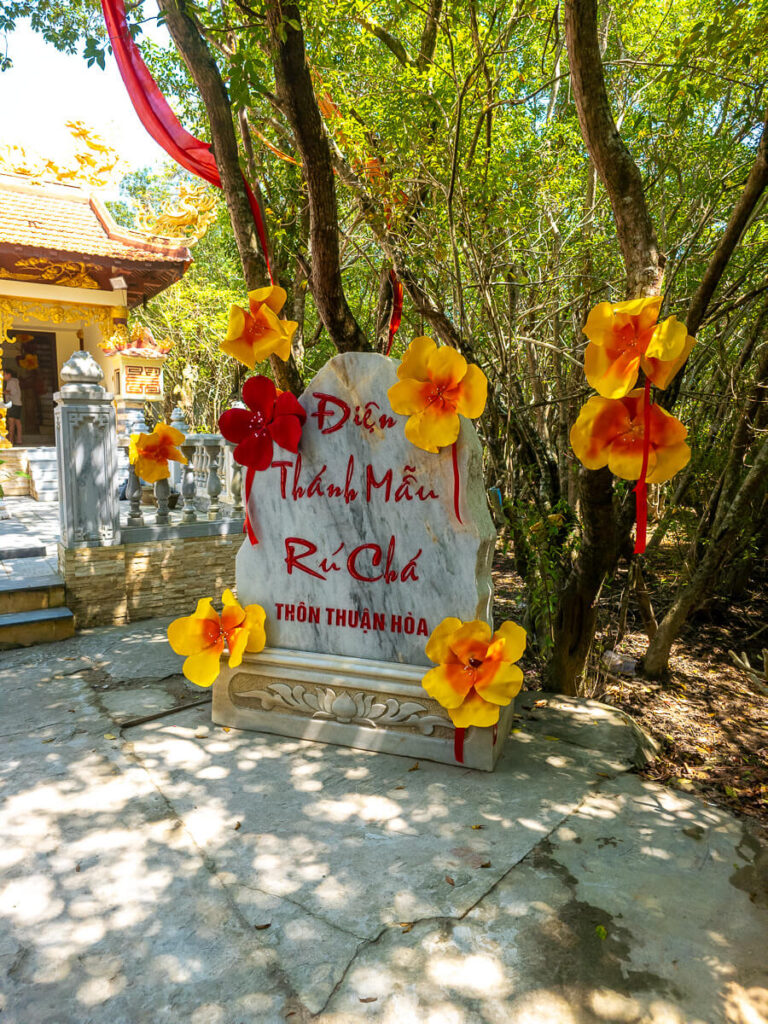
Deep within the trees sits a small shrine, Điện Thánh Mẫu, dedicated to the Holy Mother. According to local legend, during a great flood long ago, the ancestral tablet of the Holy Mother drifted downstream from Hòn Chén Temple and came to rest here. Locals treated this as significant, and the shrine grew from that event. I’m presenting this as the tradition it is rather than verified historical fact, since that’s how it was described to me and how it appears in local accounts. A caretaker has reportedly tended incense at the shrine for more than 70 years, which speaks to how seriously the local community still takes it.
What was once a difficult, boat-only area to reach has changed considerably. Roads and a bridge now connect it to the rest of Hue, and a concrete observation tower has been built within the forest, making this hidden mangrove forest near Hue far more accessible than it would have been even a decade ago.
Where Is Rung Ru Cha Mangrove Forest?
The forest sits in Thuan Hoa village, Huong Phong commune, roughly 9 to 15 kilometers from central Hue depending on the exact route taken. It borders Tam Giang Lagoon directly, with the forest itself sitting right at the water’s edge.
How to Get to Rung Ru Cha Mangrove Forest From Hue
Getting There by Scooter
I rode out on my scooter, and this is genuinely the easiest way to reach this hidden mangrove forest near Hue. From central Hue, follow Highway 49B toward Thuan An Beach. Watch for signage directing you to turn left toward Tam Giang, then cross Tam Giang Bridge. From there, it’s another 4 kilometers or so, passing Thao Long Dam, before reaching the forest itself.
The full ride took around 30 to 40 minutes for me, and the roads were straightforward the entire way, nothing technical or difficult, just a pleasant ride out through increasingly open, watery landscape as you get closer to the lagoon.
Getting There by Car
A car works fine too and follows the same route. This makes more sense for groups or anyone not comfortable on a scooter, though you lose some of the flexibility to stop along the way that riding gives you.
Finding the Entrance

Search for Rú Chá or Ru Cha Mangrove Forest on Google Maps, and the signage along Highway 49B does a reasonable job pointing you in the right direction once you’re close. Parking is informal, simply leave your scooter near the start of the walking path into the forest. I didn’t find the route particularly confusing once I’d made the turn at Tam Giang Bridge, though the final stretch through the village feels a little uncertain until the forest itself comes into view.
Exploring the Rú Chá Mangrove Forest

Walking through Rung Ru Cha Mangrove Forest feels immediately different from anywhere else in Hue. A concrete path winds through the trees, with chá roots reaching into shallow water on either side and a dense canopy overhead providing near-constant shade.
I walked the entire path through the forest, and it took maybe 20 to 30 minutes at a relaxed pace, longer if you stop often, which I did. The atmosphere is genuinely quiet, water lapping gently, birds occasionally calling from somewhere in the canopy, and almost no other visitors around during my afternoon visit. The forest’s appearance changes considerably by season, green through most of the year, before turning yellow and gold in autumn as the chá leaves change color.
Climb the Observation Tower

Partway through the forest sits a concrete observation tower, five storeys and just over 20 meters tall, with a spiral design, a red-tiled roof, and pale blue walls that stand out clearly against the green canopy surrounding it.
I climbed it myself, and it’s worth the short effort. From the top, you get a genuinely different perspective on Rung Ru Cha Mangrove Forest, the dense green canopy stretching out below, and Tam Giang Lagoon opening up beyond it toward the horizon. This is the best place in the entire forest to actually understand its scale, something the ground-level path doesn’t fully convey. The view stretching across the water made the climb worthwhile on its own.
Visit the Shrine of Điện Thánh Mẫu

Tucked among the trees, a short distance off the main path, sits Điện Thánh Mẫu, the small shrine dedicated to the Holy Mother. I found it without much difficulty once I knew to look for it, a modest structure with an old, weathered character that fits naturally into its forest surroundings.
The shrine is dedicated to the Holy Mother, connected to the flood legend described earlier involving the ancestral tablet from Hòn Chén Temple. For the local community, this isn’t a photo stop. It’s a functioning spiritual site, still visited and maintained. I approached quietly, kept my visit brief and respectful, and avoided anything that felt intrusive given its ongoing religious significance.
What Makes Rú Chá Different From Other Places in Hue?

Rung Ru Cha Mangrove Forest combines nature, local history, and spirituality in one small, unassuming area, something almost nowhere else in Hue manages in quite the same way. It feels completely unlike the Imperial City, no grand architecture, no ticketed entrance, no crowds moving through a fixed route.
There’s no polished tourist-attraction experience here. What you get instead is quiet, undeveloped, and genuinely local. That fits directly into how I approached my five days in Hue overall, seeking out the places that don’t show up on standard itineraries rather than sticking exclusively to the well-known sites.
My Experience at Rung Ru Cha
I hadn’t originally planned this as a major stop. It was somewhere I’d read about briefly and decided to ride out to almost on a whim during my time in Hue.
The ride out was pleasant, watery landscapes opening up the closer I got to Tam Giang. My first impression on arrival was how quiet everything felt, no crowds, no vendors, just the entrance to a forest path disappearing into green shade.
Walking through the trees, I felt the temperature drop noticeably under the canopy. I found the tower partway through and climbed all five levels, the view from the top genuinely one of the best moments of my time in the city. Forest below, lagoon beyond it, and almost total silence. From there, I found my way to the shrine, a quiet, slightly hidden structure that felt like a real discovery rather than something signposted for visitors.
There were a few small boats moored near the water, but since I visited in the afternoon, none were offering tours at the time. I suspect they run more actively in the morning or evening, so if a boat ride through the mangroves matters to your plans, timing your visit outside the afternoon lull is worth considering.
This ended up being the most peaceful two hours of my entire five days in Hue. Nothing about it felt curated for tourism, and that quietness, water, trees, one weathered shrine, one tower, is exactly what made it stick with me afterward.
Can You Take a Boat Through Rú Chá?
Yes, based on what I saw, local fishermen offer boat trips weaving through the narrower channels within the mangroves. I didn’t take one myself, since none were running during my afternoon visit, so I can’t speak to the exact price or duration firsthand. Based on general visitor reports, boats tend to operate more in the morning or evening rather than through the afternoon. If exploring the forest from the water appeals to you, plan your visit outside the middle of the day and ask locally about availability when you arrive.
Best Time to Visit Rung Ru Cha
Best Time of Day
Morning offers cooler temperatures and, based on what I observed, better odds of finding boats operating. Late afternoon, when I visited, still delivered excellent light filtering through the canopy and a genuinely peaceful atmosphere, though the boats weren’t running by that point.
Best Time of Year
The forest’s colors shift dramatically through the year. Most months show green foliage throughout the canopy. From late September through October, the chá leaves turn yellow and gold, considered the most visually striking time to visit. This doesn’t mean other seasons aren’t worth it, just that autumn adds a different, more dramatic character to the same walk.
How Long Do You Need at Rú Chá?
A quick visit covering just the main path takes 20 to 30 minutes. A proper visit including the tower climb and the shrine, which is what I did, takes closer to 1.5 to 2 hours. Adding a boat ride, if you time your visit right, could extend this further. I’d recommend treating this hidden mangrove forest near Hue as a half-day outing from the city, factoring in the ride there and back alongside time to properly explore on foot.
Things to Know Before Visiting Rú Chá
Wear comfortable shoes for the walking path. Bring water and sun protection, since parts of the path outside the canopy get direct sun. Insect repellent is worth packing given the wetland environment. Facilities are minimal to nonexistent, so don’t expect food or restrooms on site. Be respectful around the shrine, and avoid disturbing wildlife or wandering off the main path. Download offline maps before leaving Hue, since signal can be patchy this far out. There’s no entrance fee based on my visit.
Can You Combine Rú Chá With Other Places in Hue?
Thuan An Beach
Since the route out passes close to Thuan An, combining the two makes sense for a fuller day out from Hue. I visited Thuan An separately during my stay, and the two areas share a similar quiet, coastal atmosphere.
Tam Giang Lagoon
The forest sits directly on the lagoon’s edge, so the two are inseparable in practice. Lagoon views from the observation tower are part of what makes climbing it worthwhile.
Frequently Asked Questions About Rung Ru Cha
Where is Rung Ru Cha Mangrove Forest?
In Thuan Hoa village, Huong Phong commune, on the edge of Tam Giang Lagoon, roughly 9 to 15 kilometers from central Hue.
How far is Rung Ru Cha from Hue?
Around 30 to 40 minutes by scooter, following Highway 49B toward Thuan An before crossing Tam Giang Bridge.
How do you get to Rú Chá from Hue?
By scooter or car via Highway 49B, turning toward Tam Giang, crossing the bridge, and continuing about 4 kilometers further to the forest.
Is Rung Ru Cha Mangrove Forest free to visit?
Yes, based on my visit there was no entrance fee.
What can you do at Rú Chá?
Walk the forest path, climb the observation tower, visit the Điện Thánh Mẫu shrine, and potentially take a boat through the mangrove channels depending on timing.
Can you climb the observation tower at Rú Chá?
Yes, it’s five storeys and just over 20 meters tall, open for visitors to climb for panoramic views over the forest and lagoon.
Is there a temple or shrine inside Rú Chá?
Yes, Điện Thánh Mẫu, a shrine dedicated to the Holy Mother, connected to a local flood legend and still actively used by the community.
Can you take a boat through Rú Chá?
Yes, local fishermen offer boat trips through the mangrove channels, though based on my visit, these seemed more available in the morning or evening rather than the afternoon.
What is the best time to visit Rú Chá?
Late September through October for the yellow autumn foliage, though the forest is pleasant throughout the year. Mornings offer cooler temperatures and better odds of catching a boat trip.
How long do you need at Rú Chá?
Around 1.5 to 2 hours for a proper visit including the tower and shrine, treated best as part of a half-day outing from Hue.
Conclusion
Rung Ru Cha Mangrove Forest showed me a completely different Hue than anything I’d seen up to that point. The forest itself, the tower rising above the canopy, the quiet shrine tucked among the trees, and the still water of Tam Giang Lagoon all came together into something that had nothing to do with the city’s famous imperial history.
The most memorable part wasn’t any single element. It was simply the feeling of being somewhere quiet, local, and completely undeveloped for tourism. My personal takeaway from visiting is straightforward: sometimes the best two hours of a trip come from a place you almost didn’t bother researching at all.
Planning Your Vietnam Trip?
If you’re building a bigger Vietnam itinerary, here’s what else I’ve written:
Hue Travel Guide for Slow Travel: 5 Days Beyond the Imperial City
Hue Abandoned Water Park Guide 2026: What to Know Before You Visit
Getting From Ninh Binh to Hue: Complete Transport Guide 2026
Vietnam Itinerary for Slow Travel: My 50-Day Route Through the Real Vietnam