Escape the typical tourist route and explore Bon Van Duy Vinh on Cam Kim Island. Discover how to find this hidden boat temple in Hoi An during your trip. (CLICK HERE)
Table of Contents
This hidden boat temple in Hoi An is one of the lesser-known places I found while exploring beyond the Ancient Town, a small shrine tucked into a fishing village on Cam Kim Island that most visitors to Hoi An never come across, let alone hear about.
Its name is Bon Van Duy Vinh, and unlike almost everything else on a typical Hoi An itinerary, it isn’t built for tourists. It’s a working part of a local fishing community, sitting quietly across the river from the lanterns and crowds that define the tourist version of this city.
That contrast, between the polished, curated Hoi An most visitors experience and the quieter local side hiding just across a bridge, is really what this hidden boat temple in Hoi An represents.
Quick Information
| Information | Details |
| 📍 Location | Bon Van Duy Vinh |
| 🛕 What it is | A small boat-shaped shrine known locally as Boat Temple |
| 💰 Entrance fee | Free |
| 🕐 Opening hours | No fixed opening hours |
| ⏱️ Time at the temple | 10–15 minutes |
| 🚲 Best way to get there | Bicycle or scooter |
| 🛵 From Hoi An | Around 30–45 minutes by bicycle, depending on stops |
| 🌾 Setting | Local fishing village and countryside |
| 🚻 Facilities | No restrooms, shops, or tourist facilities |
| 🙏 Good to know | This is an active local religious site, so be respectful when visiting |
What Is Bon Van Duy Vinh?

Bon Van Duy Vinh is a small shrine built in the shape of a boat, standing in a fishing village on Cam Kim Island. It’s known locally as the Boat Temple, a fitting name given its unmistakable form.
It’s directly connected to the local fishing community that surrounds it, built as a shrine to protect fishermen and their vessels rather than as a religious site designed to draw visitors. This is what makes this hidden boat temple in Hoi An different from the city’s better-known temples and pagodas. Places like Chua Cau or the larger pagodas within the Ancient Town were built with a level of permanence and public visibility in mind. Bon Van Duy Vinh wasn’t. It exists quietly, for the people who actually use it.
The cultural significance here is real without needing to be exaggerated. It represents a living tradition among Vietnam’s coastal fishing communities, a practice that continues regardless of whether any tourist ever finds their way here.
The History of Bon Van Duy Vinh

Bon Van Duy Vinh belongs to a category of shrine found throughout coastal central Vietnam known locally as a “Bổn Vạn,” a guardian shrine built by a fishing guild or fishing community, referred to as a “vạn.” This tradition is genuine and well-documented along the Quang Nam coastline, closely tied to the fishing villages of Cam Kim and the surrounding Duy Vinh area.
I wasn’t able to find a precise, verified founding date or the name of a specific builder for this exact shrine, and I’d rather be upfront about that than invent details that sound authoritative but aren’t confirmed. What is consistent across shrines of this type is their original purpose: to honor protective deities associated with the sea, giving local fishing families a place to pray for safety before heading out on the water and to give thanks after returning safely.
The boat form is significant precisely because it mirrors what it protects. Rather than a conventional temple structure, the shrine takes the shape of the vessels it watches over, a direct visual link between the building and the livelihood it represents.
Based on what I observed during my visit, incense still burning, small offerings left at the shrine, this hidden boat temple in Hoi An’s countryside is clearly still in active use by the local community today, maintained as a functioning part of daily and seasonal fishing life rather than preserved as a historical curiosity.
Where Is the Hidden Boat Temple in Hoi An?
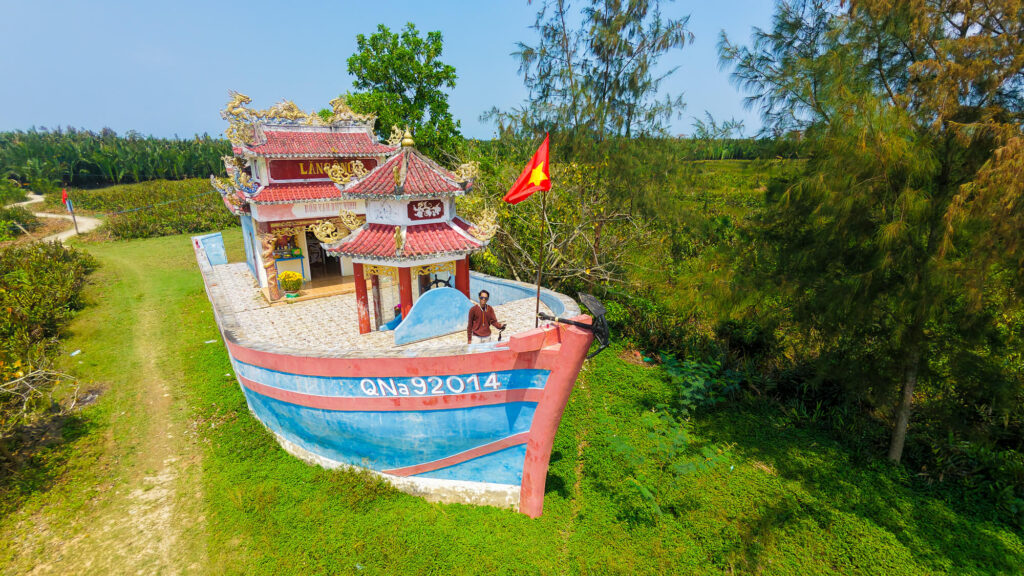
Bon Van Duy Vinh sits within the fishing villages of Cam Kim Island, in the Duy Vinh area just across the river from Hoi An’s Ancient Town. Cam Kim is also sometimes called Kim Bong Island locally, historically known for carpentry and boat-building traditions, which makes a boat-shaped shrine feel especially fitting here.
In relation to the Ancient Town, the distance is minimal in a straight line, just across the water, though actually reaching this hidden boat temple in Hoi An requires crossing onto the island and riding through several village roads once you’re there. Its connection to Duy Vinh and Cam Kim runs deep, since the shrine exists specifically because of the fishing communities based in this part of the island.
Approximate travel time by bicycle from central Hoi An, including the bridge crossing, is somewhere around 30 to 45 minutes depending on how directly you ride and how many stops you make along the way, which in my case was quite a few.
For the exact search term, look for Bon Van Duy Vinh (Boat Temple).
How to Get to Bon Van Duy Vinh
Getting to Bon Van Duy Vinh is fairly straightforward, and you can make the trip by either bicycle or scooter. Both can be rented easily in Hoi An, although I’d personally recommend a bicycle if you have the time, since riding through Cam Kim Island and the surrounding villages is a big part of the experience.
From Hoi An, you’ll cross the bridge onto Cam Kim Island and then continue through the village roads toward the Duy Vinh area. The ride itself isn’t particularly difficult, but finding the shrine can be a little less straightforward once you’re off the main roads.
I’m mentioning the Google Maps location here so you can open it and use it while you’re making the trip. Since this is a small local shrine without prominent signage, having the map open on your phone will make finding the general location much easier.
Location – Bon Van Duy Vinh (Boat Temple).
What to Expect When Visiting

Set your expectations accurately before you go: this hidden boat temple in Hoi An is a small local shrine, not a major attraction, and treating it as anything else will lead to disappointment.
The size and layout are modest, a single boat-shaped structure rather than a sprawling temple complex. What you can actually see is straightforward: the shrine itself, incense, and small offerings left by local fishing families.
The surrounding village and fishing-community setting is arguably as much a part of the experience as the shrine itself, boats docked along the water, modest homes, and the quiet rhythm of daily fishing life continuing around you.
There’s no entrance fee, since this isn’t a managed tourist site with any kind of ticketing in place. There are no fixed opening hours either, since it functions as a community shrine rather than an attraction with posted hours. Facilities are essentially nonexistent, no restrooms, no shop, nothing built for visitors specifically.
Whether anyone is around varies. When I visited, the village felt quiet, with occasional locals going about their day rather than any dedicated caretaker present at the shrine itself.
What makes the experience different from a conventional tourist attraction is exactly this lack of infrastructure. There’s nothing performing for you here. Basic etiquette matters accordingly: approach quietly, be respectful of the site’s religious significance, and avoid touching offerings or interfering with anything left at the shrine.
My Experience Finding the Hidden Boat Temple

I was cycling around Cam Kim Island with genuinely no fixed plan, the kind of ride where you pick a direction and just see what happens. I’d already crossed the bridge from Hoi An and had been riding through village roads and past small farms for a while before I found this hidden boat temple in Hoi An entirely by chance.
Before I found it, I was simply exploring, no destination in mind, riding through narrow roads past homes with small gardens and the occasional local passing the other way on a bicycle. What made me stop and investigate was the shape itself. Even from a distance, the boat form was unmistakable, and it took me a moment to actually understand what I was looking at before getting closer.
My first reaction was surprise, followed by curiosity. Up close, the incense still burning and the small offerings left nearby made it immediately clear this wasn’t an abandoned structure or a curiosity left for tourists. It was actively being used, part of a community’s ongoing daily and seasonal life.
I saw a handful of locals nearby, going about their business rather than paying particular attention to a visitor on a bicycle. I didn’t have any extended interaction with anyone, more a quiet, respectful observation from a short distance rather than a conversation. What stayed with me afterward wasn’t a single dramatic moment. It was the accumulation of the whole ride: the slow pace of cycling, the genuine surprise of finding something I hadn’t planned for, and the sense that I’d seen a small piece of local life that has nothing to do with Hoi An’s tourism industry at all.
This connects directly to my broader nine days in Hoi An. The version of the city most visitors experience is only one layer, and finding this hidden boat temple in Hoi An’s countryside is exactly the kind of thing that layer hides underneath it.
How Long Do You Need at Bon Van Duy Vinh?

Time needed to see the temple itself is short, perhaps 10 to 15 minutes to properly look around and take it in respectfully. This isn’t a place designed to occupy hours of your time on its own.
Time worth allowing for the surrounding area is where the real value lies. Give yourself at least an hour beyond the shrine visit to ride through the village roads, see the fishing boats along the water, and take in the general atmosphere.
For a bicycle visit, I’d recommend budgeting at least half a day total, including the ride there, time exploring Cam Kim’s villages, the shrine visit itself, and the ride back. For a scooter visit, this could be shortened somewhat, perhaps three to four hours total, if you’re combining it with other stops and moving more efficiently between them.
The journey itself deserves some time regardless of which option you choose. The riding, not just the destination, is a significant part of what makes visiting this hidden boat temple in Hoi An worthwhile.
Best Time to Visit the Hidden Boat Temple in Hoi An
Best Time of Day
Morning offers cooler temperatures for cycling and generally more visible local activity, since fishing communities tend to be active earlier in the day. Late afternoon works well too, with softer light for photos and a noticeably calmer feel as the heat of the day passes.
I visited in the afternoon, and the light combined with the quiet of the village made for a genuinely peaceful atmosphere around this hidden boat temple in Hoi An’s setting.
Best Time of Year
Weather matters more here than at most Hoi An attractions, since the entire experience depends on cycling through open countryside. Drier months make for more comfortable riding conditions overall.
Rain doesn’t necessarily rule out a visit, but it does change the experience. I rode through heavy, sudden rain during parts of my time exploring Cam Kim Island, and while it made the roads wetter and the ride more physically demanding, it also added a strange, memorable quality to riding through quiet fishing villages with nobody else around. If you don’t mind getting wet, don’t let rain stop you from exploring this hidden boat temple in Hoi An’s countryside.
Things to Know Before Visiting
Dress respectfully, as you would at any religious site, even one as modest and undeveloped as this shrine.
Be considerate when taking photographs. Photograph respectfully rather than treating the shrine as a backdrop, and be mindful of any locals present nearby.
Remember that this is a local religious site, not a tourist attraction, and approaching it with that understanding shapes the entire experience. Don’t expect tourist facilities, since nothing here is built for visitor convenience.
Carry water, since the countryside roads leading to this hidden boat temple in Hoi An have few, if any, shops along the way. Download maps before leaving Hoi An, since relying on live data in more rural parts of Cam Kim Island isn’t something you should count on.
Be respectful if local worship or ceremonies are taking place. If you arrive and locals are actively using the shrine, it’s worth stepping back and giving them space rather than approaching immediately.
Don’t expect English information on site. There’s no signage explaining the shrine’s history or significance, which is part of what makes this hidden boat temple in Hoi An feel genuinely undiscovered rather than packaged for visitors.
What Else Can You See Near Bon Van Duy Vinh?
Cam Kim Island
This hidden boat temple in Hoi An fits naturally into a broader Cam Kim Island ride, since it’s one of several things worth finding across the island’s villages and countryside roads. For a fuller picture of what else the island offers, see my complete Cam Kim Island guide.
Cầu Máng Duy Phước
The connecting bridge nearby makes for a natural additional stop that can be combined with the temple on the same countryside ride, another piece of local infrastructure worth seeing rather than a major attraction in its own right.
Exploring the Hoi An Countryside
Rice fields, fishing villages, and rural roads throughout this part of Quang Nam reward exactly the kind of spontaneous, unplanned exploration that led me to this shrine in the first place. These small local communities are genuinely worth exploring without a fixed itinerary, since the best finds, like this hidden boat temple in Hoi An, tend to happen when you’re not searching for anything specific at all.
Frequently Asked Questions About the Hidden Boat Temple in Hoi An
Where is the Hidden Boat Temple in Hoi An?
It’s located within the fishing villages of Cam Kim Island, in the Duy Vinh area just across the river from Hoi An’s Ancient Town.
What is the Boat Temple in Hoi An called?
It’s known as Bon Van Duy Vinh, commonly referred to simply as the Boat Temple due to its distinctive boat-shaped structure.
When was Bon Van Duy Vinh built?
A precise, verified founding date for this specific shrine isn’t publicly documented, so I won’t state one with false confidence. It belongs to the broader tradition of “Bổn Vạn” guardian shrines built by fishing communities along the Quang Nam coast.
Why was Bon Van Duy Vinh built?
Shrines of this type are built by local fishing communities to honor protective deities associated with the sea, offering a place to pray for safety before fishing trips and give thanks upon return.
Why is it called the Boat Temple?
The shrine takes the physical form of a boat, symbolically connecting its structure to the fishing vessels and livelihoods it’s meant to protect.
How do you get to the Boat Temple from Hoi An?
By bicycle or scooter, crossing the bridge onto Cam Kim Island and riding through village roads in the Duy Vinh area. I visited by bicycle, which took roughly 30 to 45 minutes including stops along the way.
Is the Boat Temple in Hoi An free to visit?
Yes, there’s no entrance fee, since this is a community shrine rather than a managed tourist attraction.
Can you visit the Boat Temple and Cam Kim Island together?
Yes, and you effectively have to, since this hidden boat temple in Hoi An sits within Cam Kim Island itself rather than being a separate destination.
Conclusion
Hoi An’s Ancient Town gets the lanterns, the crowds, and nearly all of the attention. This hidden boat temple in Hoi An gets none of that, and that’s exactly the point. It’s not trying to be a major attraction. It’s a small, functioning shrine built by and for a fishing community that has nothing to do with the tourism economy just across the river.
What made it memorable wasn’t its size or a history I could confidently recite, since I genuinely can’t claim to know its exact origins with certainty. It was the process of finding it: an unplanned bicycle ride through quiet villages, a shape that didn’t make sense until I got closer, and the quiet realization that I’d seen a piece of local life most visitors to Hoi An never encounter at all.
That’s my real takeaway from discovering this hidden boat temple in Hoi An. Some of the best things you find while traveling aren’t the ones you plan for. They’re the ones you stumble onto because you decided to keep riding a little further than you needed to.
Planning Your Vietnam Trip?
If you’re building a bigger Vietnam itinerary, here’s what else I’ve written:
Hoi An Travel Guide for Slow Travelers 2026: Beyond the Lanterns
Hoi An Budget Guide 2026: How much is the cost of visiting Hoi An?
Hidden Places in Hoi An: 5 Spots Beyond the Old Town
Cam Kim Island Guide 2026: Hoi An’s Quiet Countryside Escape
Best Day Trip From Hoi An: Khe Tan Reservoir (2026 Guide)
Hoi An River Boat Ride: 2026 Prices, Times & Complete Guide
Things to Know Before Visiting Hoi An: Travel Tips for First-Time Visitors